From Recognition to Adaptation: How a Self-Developed OCR Training Platform Helps Business Systems Handle Complex ID and Document Scenarios
2026-06-12From Recognition to Adaptation: How a Self-Developed OCR Training Platform Helps Business Systems Handle Complex ID and Document Scenarios
In many identity verification, customer registration, document processing, and business onboarding scenarios, OCR is no longer just a tool for “recognizing text from an image.”
For hotels, banks, government service centers, visitor management systems, transportation services, telecom operators, enterprise platforms, and many other industry systems, the real value of OCR is not only the text itself. What customers truly need is structured, accurate, and usable data that can enter their business systems directly.
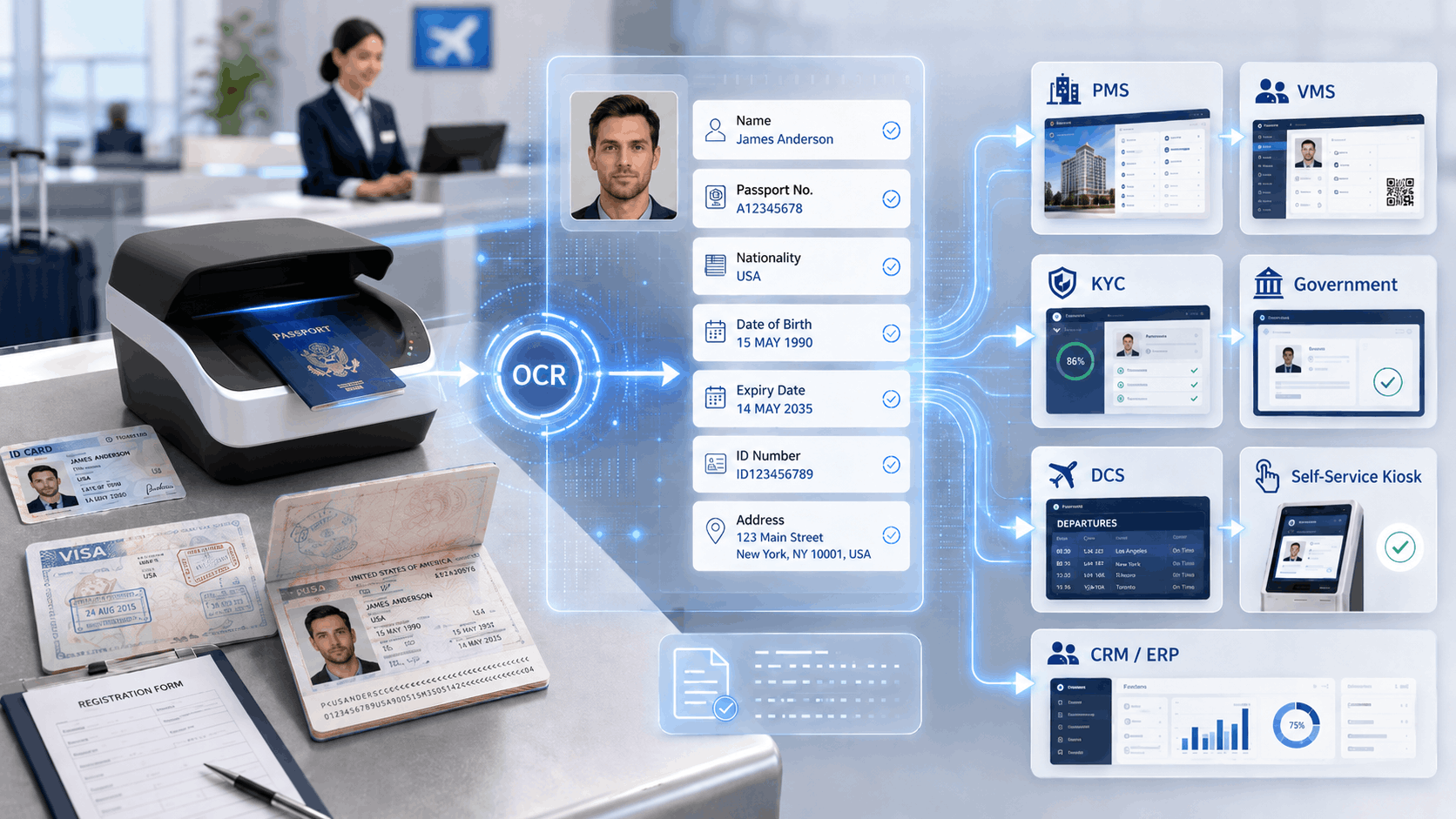
When a passport is read, the system does not only need a visual copy of the document. It needs key identity fields such as name, passport number, nationality, date of birth, gender, expiration date, MRZ information, and other structured data. When an ID card is processed, the system may need fields such as ID number, full name, address, issuing authority, validity period, and document type. In banking, enterprise verification, public services, and document archiving, invoices, business licenses, bank forms, application documents, and supporting materials also need to be converted into data that can be searched, checked, submitted, and managed.
This is where OCR faces a more practical challenge in real business environments.
Recognition is only the first step. The more important question is how to make the recognition result stable, accurate, configurable, and continuously adaptable to different business scenarios.
For standard passports and common document types, mature OCR models can help customers capture information quickly. However, in real projects, different countries, regions, institutions, and business systems often have very different requirements. Even within the same category of identity documents, the layout, language, field names, security background, printing quality, and image capture environment may vary greatly. Even within the same type of business form, different organizations may use different templates, field positions, stamps, handwritten content, scanning quality, and internal rules.
If a solution only relies on a fixed model or a general OCR engine, many customers may face a common problem: the system can recognize text, but it may not always recognize the exact fields required by the business. It may work well with common samples, but become less stable when facing new templates, new document versions, new languages, or low-quality images. It may be suitable for a demonstration, but still require continuous optimization before it can be used in a large-scale business environment.
Therefore, OCR for industry applications cannot remain only at the level of general text recognition. It must be able to adapt to real business scenarios.
SinoSecu’s self-developed OCR training platform is built for this purpose.
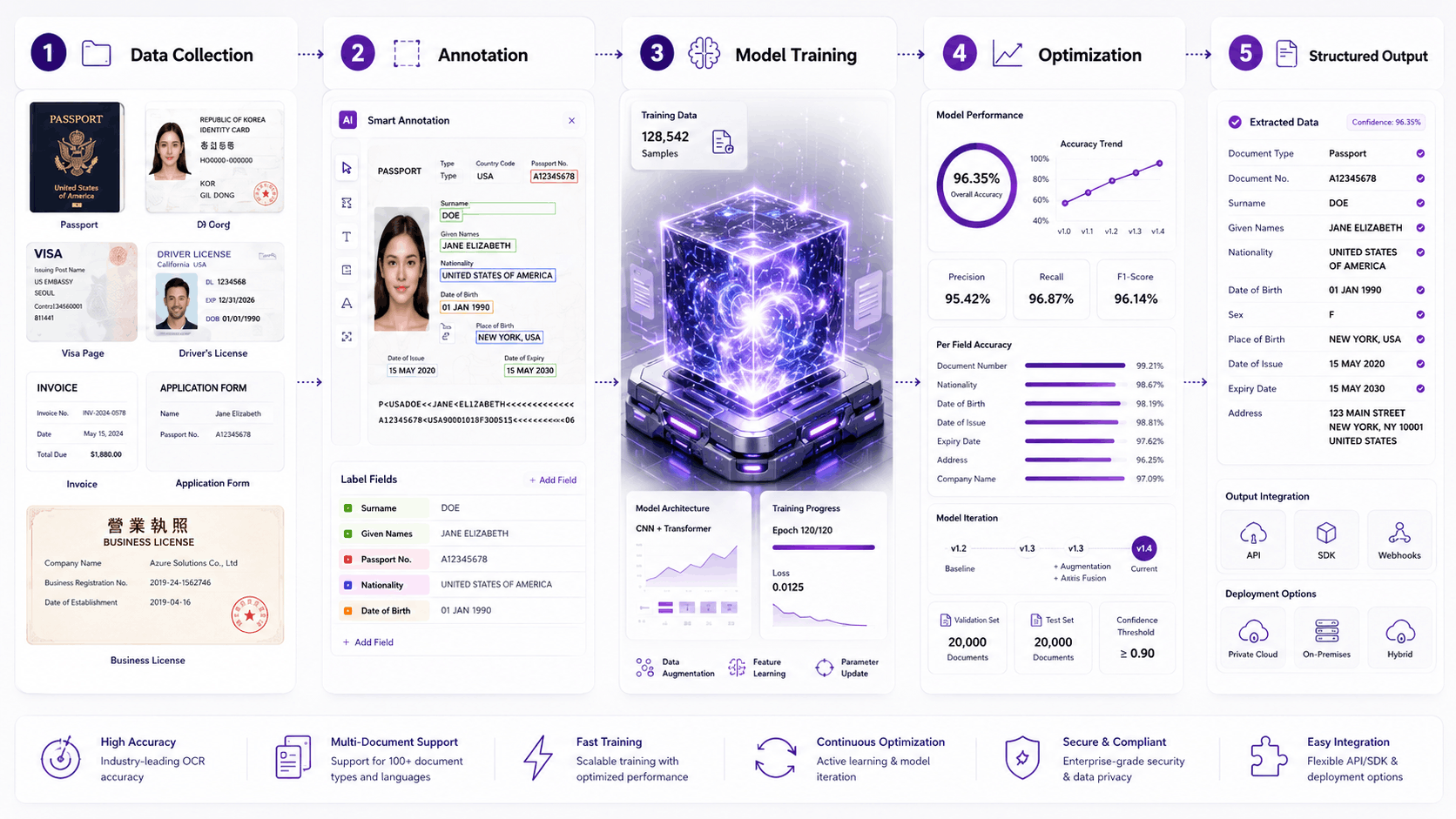
With our own training platform, we can process customer samples, build datasets, perform annotation, train models, test recognition results, optimize field extraction, and improve the overall system performance according to real project requirements. For passport reader and identity document recognition products, this means the system can not only support standard passport MRZ reading, but also gradually expand its recognition capability for more national ID cards, driving licenses, residence permits, work permits, visa pages, travel documents, and other identity-related documents according to project needs.
For document OCR and form recognition scenarios, it means the system can be trained around the customer’s real templates, helping the customer extract the required fields more accurately and more consistently.
In many projects, customers are not simply asking whether OCR can recognize characters. They are asking more practical questions: Can it support our local ID documents? Can it extract the fields required by our business system? Can it connect with our existing workflow? Can it continue to adapt when a new template appears? Can the recognition results be stably exported to PMS, VMS, KYC, DCS, CRM, ERP, government platforms, or other business systems?
Behind all these questions is the same demand: OCR must become a reliable data entry point for business systems.
This is the value of a self-developed OCR training platform.
First, it improves scenario adaptability. Different customers, countries, and systems do not always require the same fields. Through a dedicated training platform, the OCR capability can be optimized based on real samples and real workflows. In a hotel front desk scenario, the system may focus on fast passport and ID data capture. In a banking or KYC scenario, it may focus more on identity accuracy, field completeness, and audit requirements. In a visitor management scenario, it may focus on registration efficiency, access records, and security management. In a government or industry service scenario, it may need to support multiple document types, multiple forms, and more complex data structures.
Second, it helps reduce uncertainty during system integration. For software companies and system integrators, integrating OCR is not only about connecting a device, SDK, or API. More importantly, the recognition result must be stable enough to enter the customer’s own system. If the output fields are unstable, the format is inconsistent, or the template adaptation capability is limited, the business system may still need additional manual checking or rule-based correction. With a self-developed training platform, SinoSecu can design and optimize models, field rules, and data output formats around the customer’s actual business requirements from the early stage of a project.
Third, it supports continuous project iteration. Real business environments are not static. New document versions may appear. New forms may be added. Customer field requirements may change. Capture devices, image quality, and usage environments may also evolve over time. A self-developed training platform allows us to keep improving the OCR model with additional samples and project feedback, so the recognition capability can grow together with the customer’s business instead of remaining fixed after initial delivery.
This is especially important in international markets.
Different countries and regions have different identity document systems. Hotels, airports, banks, telecom operators, government agencies, visitor management providers, and system integrators may all face different types of documents. Some projects may require local ID card recognition. Some may require passport and visa page recognition. Some may require driving license or residence permit recognition. Others may need to process identity documents, business forms, invoices, and supporting files together.
Without continuous training and customized adaptation capability, it is difficult for OCR products to truly enter the core workflow of the customer.
SinoSecu’s goal is not only to provide a single recognition function. Our goal is to help customers build a more complete capability for identity data capture and intelligent document processing.
In passport reader scenarios, we hope our devices can do more than image capture and MRZ reading. We want them to become reliable data entry points for business systems. In ID document OCR scenarios, we aim to help customers reduce manual input and improve the efficiency of identity information capture. In document recognition scenarios, we hope to convert complex paper materials, scanned files, and document images into usable, manageable, and transferable business data. In system integration scenarios, we support flexible connection methods such as SDK, API services, and private deployment, so OCR capability can be naturally embedded into existing workflows.
For end users, this means faster service, less repeated form filling, and a smoother experience. For frontline staff, it means less manual typing, fewer field checks, and lower operational pressure. For software developers and system integrators, it means they can add more professional identity data capture and document recognition capabilities to their existing products. For enterprises and public institutions, it means that data collection can become more standardized, automated, and traceable.
In the future, the competition in OCR will not only be about recognition accuracy. It will also be about scenario adaptation, structured data extraction, continuous training capability, and system integration capability.
As more industries connect physical documents, paper materials, identity records, and digital systems, OCR will become an important entry point for business digitalization. A truly practical OCR solution requires more than a general recognition model. It needs a technical system that can learn from business samples, understand industry fields, adapt to real workflows, and keep improving over time.
SinoSecu will continue to rely on its OCR technology, passport reader products, document recognition capability, and self-developed training platform to provide more flexible, stable, and practical identity recognition and intelligent document processing solutions for global customers.
Whether the scenario is hotel check-in, visitor registration, financial KYC, airport service, government processing, enterprise verification, or any other workflow that requires identity data and document data capture, we hope to help our partners turn complex documents into usable data, transform manual input into automatic capture, and make OCR a truly intelligent entry point for business systems.
From recognition to adaptation, from images to data, and from a single tool to a complete workflow, SinoSecu will continue to bring OCR technology into more real-world business scenarios.
By Sinosecu